
Here are two familiar birds: Mallard and Magpie. A duck might seem incongruent in a village like ours, but there are plenty of ponds around Bredfield that will serve as suitable breeding locations for Mallards. It’s a heart-warming and a not too usual sight to see a mother with her seven-or-eight ducklings parading around the village. In my estimation, drake Mallards are one of the most beautiful ducks in Britain but, for many people, familiarity has inured them from appreciating their beauty. Still, they are generally well-liked birds and familiarity has not bred contempt. The same may not be said for our other familiar bird, the Magpie, which has become something of a folk devil. It is associated with misfortune, thievery and raiding the nests of song birds. Traditionally, the only way to counteract the ill-luck associated with meeting a Magpie was to salute it and say “good morning”. The Magpie’s machine-gun rattle sounds discordant aside the delight of the calls and songs of other birds. Can the Magpie be rescued from this bad reputation? Let’s have a go.
The first thing to be said is that not all Magpie folklore is negative. It may be “one for sorrow”, but remember that it’s “two for joy”. People probably say this because Magpies are loyal to their partners and usually seen in pairs. If you see just one, it is perhaps because the partner has died, bringing sorrow. Fidelity in relationships is a good thing, so there’s the first positive for the Magpie. The second positive in its favour is that Magpies are probably our most intelligent bird. The person who coined the term ‘bird brain’ couldn’t have had the Magpie in mind.
The main accusation against the Magpie is that their nest-raiding habits have brought a decline in the numbers of our much-loved song birds. That’s quite a charge to face! What can be said in the Magpie’s defence? The first thing we should remember is that Magpies are successful birds because they are opportunistic omnivores. They will eat almost everything: seeds from under your bird-feeder; chips spilled on city pavements; larger insects; and they will help clean-up any animal carcass left around (a very useful service). Birds’ eggs will constitute a very small percentage of their diet. When assessing the reasons for the decline in song bird numbers, there is an elephant in the room. Or rather, a cat. I will stroke a friendly cat on my lap any day, but I know that inside that contented purring friend lurks a potential bird-killer. According to the RSPB, cats in Britain are responsible for the death of at least 27 million birds per year. The Magpie plays in a minor league compared to this scale.
It always pays to remember that, all other things being equal, nature evolves into a balance – including a balance between predators and the predated. Magpies and song birds have coexisted for thousands of years; long before there were gamekeepers who, some say, served to keep Magpies in check. If there has been a recent decline in song birds, the main reasons for this will be because of some larger change in our modern world. Certainly, habitat loss and climate change has not made it easier for many birds. When Willow Warblers arrive in the summer, they may find that the copse they were born in has vanished, or they may find that Spring has started earlier and the insect larvae that they usually feed on have already emerged and gone. It would be misguided to blame the Magpie for all this.
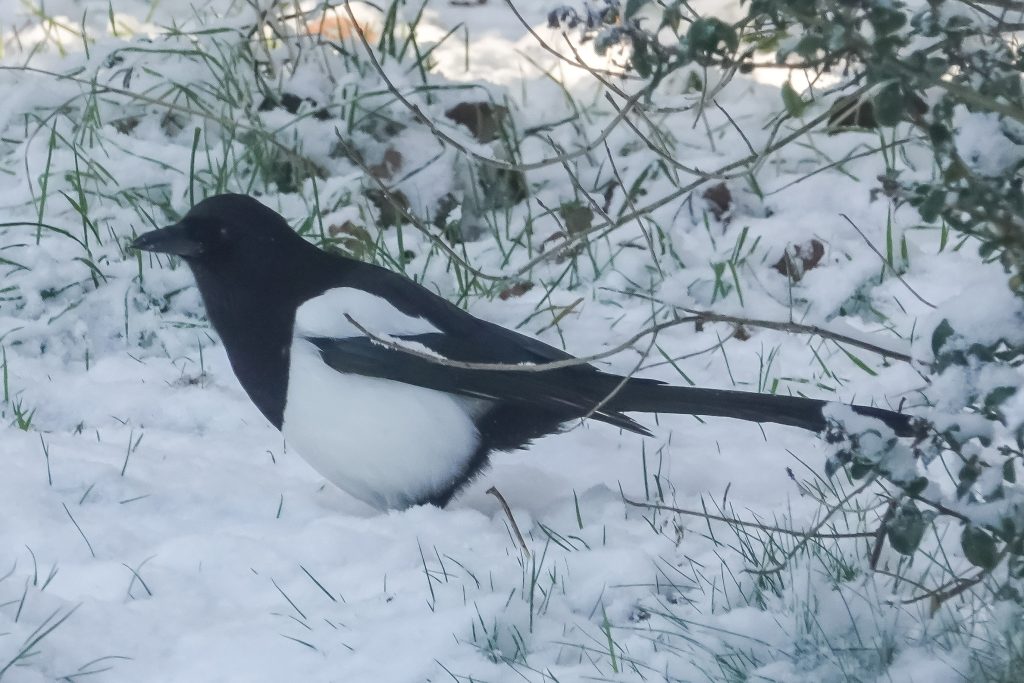
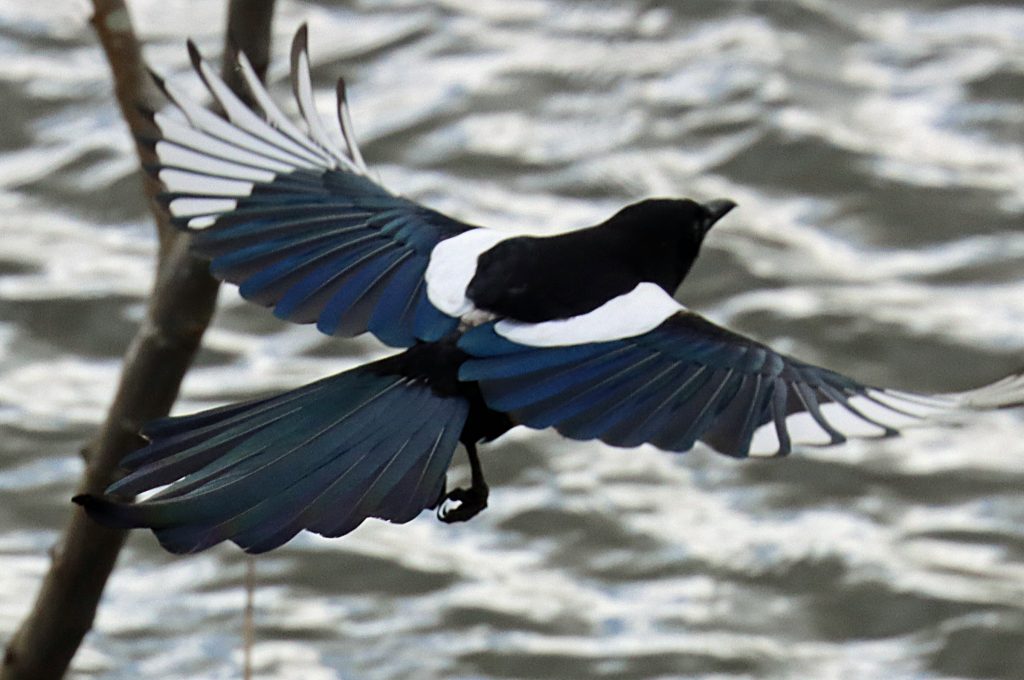
How am I doing? Are you now willing to view to our Magpie in a slightly more positive way? I hope so. Moreover, once you get past the negative perception of the Magpie, you should be able see it as a very beautiful bird. I have had visitors from the eastern seaboard of the United States see a Magpie for the first time, and be amazed what stunning birds they really are! Ever found a Magpie feather? Look closely next time; what iridescent blues, greens and blacks are to be found there.
Photographs taken by the author.