A cold winter’s day and the prospect of trudging through Suffolk’s claggy clay doesn’t appeal. Don’t fear, we can still engage with nature through reading one of the many nature books that are available.. Nature writing has never been more poplar and there is a wealth of excellent nature books in print. Allow me to suggest just a few.
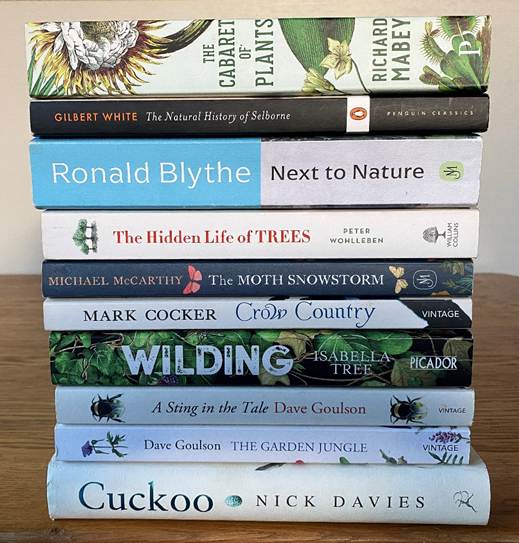
Richard Mabey is probably Britain’s foremost nature writer. If I was to pick just one of his books, I would recommend ‘The Cabaret of Plants’ (Norton & Co.) It is a wonderfully illustrated book about the botany and folklore of series of spectacular plants.
Mark Cocker is also a notable nature writer. He lives on the Suffolk-Norfolk border and one of his books – ‘Crow Country’ (Vintage) – explores the life of the immense rookeries that exist in that part of the world. The book describes his outings to learn more about an aspect of nature that is highly visible, but poorly understood. A revelation.
Dave Goulson is Professor of Biology at Sussex University, and a prolific proselytiser about the importance of conserving bees. His book ‘A Sting in the Tale’ (Vintage) is an easy, yet educational book and you’ll learn a lot about bees. If you’re interested in wildlife-friendly gardening, his book ‘The Garden Jungle’ (Vintage) explores the biodiversity potential of the average garden.
Nature books that explore one particular species in detail are referred to as monographs. Perhaps the best example is Nick Davies ‘The Cuckoo: Cheating by Nature’ (Bloomsbury). David Attenborough describes it as a “fascinating study which solves many of the puzzles surrounding this most extraordinary bird”.
One of the most successful and most visited rewilding projects is the Knepp estate in West Sussex. Isabella Tree’s best-selling book ‘Wilding’ (Picador) tells the story of how the Knepp estate was transformed from a traditional country house and grounds to a thriving haven for nature – Storks and all! The book also reveals much of interest about nature in Britain.
One of the people that Isabella is indebted to, for gaining an understanding of trees and their conservation, is Peter Wollbeben. His book ‘The Hidden Life of Trees’ (Collins), with its account of the ‘wood-wide web’, will astound you.
It is now well-studied and documented that insect populations have suffered a dramatic decline in recent years – with severe repercussions. There is no better book on this subject than Michael McCarthy’s ‘The Moth Snowstorm’ (John Murray).
Writing about nature in its local setting has in roots firmly in one pioneering book: Gilbert White’s, ‘The Natural History of Selbourne’ (Penguin Classics). Published in 1789, it still remains a good read.
Ronald Blyth lived almost all his life on the Suffolk-Essex border and is the author of ‘Akenfield’, a book you may be familiar with. In his later years, he was a lay preacher and wrote a regular contribution to the Church Times under the title Word from Wormingford. These writings can now be found in a new collection entitled ‘Next to Nature: A Life in the English Countryside’ (John Murray). It is a delightful, month-by-month, blend of village life, nature and ecclesiastics.
Happy reading.